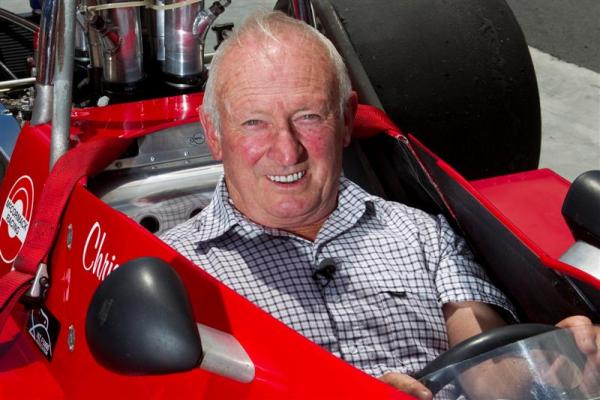
Vettel's F1 career started in 2007 and, in his first three years, he took nine podiums and five wins, though this was nothing on what was to come. Over the next four years he became the face of F1, winning four consecutive championships and becoming the youngest world champion in the process . Chris Amon holds the record for most laps led and most pole positions without a win. The driver from New Zealand scored 11 podiums from his 96 starts in the 1960s and 1970s, but terrible luck and poor reliability prevented him from claiming an elusive victory. Amon led seven races during his career with Ferrari, March and Matra, but suffered a series of heart breaking retirements within sight of the chequered flag.

Despite never standing on the top step of the podium at a championship race, Amon did score eight victories in non-championship F1 races and also won the Daytona 24 Hours and Le Mans 24 Hours. His controversial victory at Le Mans in 1966, which was shared with countryman Bruce McLaren, was dramatised in the hit 2019 film, Ford vs Ferrari. He made a 46 years unbeaten record by winning the most World Championship of Drivers starting from 1951 and then 4 consecutive times from 1954 to 1957. With 24 wins, 29 highest pole positions, 35 podiums, 245 career points, and 23 fastest laps, he decorated his career with the greatest possible success. Nick Heidfeld holds the record for most podium finishes in Formula 1 without a win. The German driver stood on the podium 13 times from his 183 starts, but never on the top step.

Heidfeld spent much of this career fighting for points in the midfield with Sauber, though he did enjoy several competitive seasons when the team was partnered with BMW in 2007 and 2008. The closest Heidfeld came to tasting victory was at the 2007 Canadian Grand Prix, where he finished four seconds behind race winner Lewis Hamilton. He attended the last race of his career in the 2012 Brazilian Grand Prix and finished in 14th place.

He won 91 races in total in his successful career which includes most of the major championships with the fastest laps and highest pole positions along with 72 Grand Prix victories. An anonymous reviewer offered good insight regarding how one classifies the 'best' or most 'successful' driver. Specifically, they asked rhetorically, "is not the "best" driver the driver who wins the championship?

During the period of our analysis, the turbo era, it was the case that the championships were dominated by one team, Mercedes-Benz. Therefore, we could not use championships as the outcome of interest because there would be no variation, despite the fact that there were two individual drivers who won individual championships for that same team. All of this aside, we believe that much more attention should be devoted to assessing different metrics of success over longer periods of time within the F1 context as well as with other sports more generally. We thank the anonymous reviewer for this excellent suggestion. He is the only driver in F1 history who finished in 1st position in 5 consecutive seasons from 2000 to 2004. The two-time world champion left F1 as its third-highest rated driver in the 2018 season, then spent two years dabbling in SportsCar and IndyCar racing.

Elo currently has Alonso ranked sixth in the field, with the sixth-best reliability score as well, after decaying his rating to reflect his time away from the sport. In the end, there will never be a cessation of ranking professional athletes based on some definition of success, whether by individual statistics, victories, or championships. Our work in this space focused on Formula 1 drivers in the turbo area. Future studies tracking drivers, points, car manufacturers, and upcoming changes to the rules and regulations, especially team budgets, may alter how the drivers are parceled across groups based on performance. In the better-performing group , we see some of the world's best drivers, such as Vettel, Bottas, and Ricciardo.

What is really interesting about the make-up of this group is the inclusion of Verstappen and especially LeClerc. The former started his F1 career in 2015, where he earned a mere 47 total points. Yet, from 2016 through 2019, he averaged well over 200 points.

The latter, however, only had two years of data to provide to the model, but the second year of LeClerc's tenure in F1 saw him move to Ferrari, and he dueled his teammate Vettel all season long, actually outscoring him 264 to 240. Finally, Group 3 contains the low-performing drivers, comparatively speaking vis-à-vis the other two groups. Many of the drivers in this list incurred zero points during their tenure, but others scored quite well, and in fact, the list contains former F1 world champions Button and Alonso. Yet, these individuals accumulated their best scoring points and titles prior to the introduction of the turbo-era in 2014. Another German driver to hold several unenviable F1 records is Nico Hülkenberg, who has competed in the most races without scoring a podium and has also scored the most points without a win. Hülkenberg graduated to Formula 1 with Williams in 2010 after claiming the GP2 title the previous year at his first attempt.

Despite recording a surprise pole position in Brazil, he was generally outclassed by his more experienced teammate Rubens Barichello and was not retained by Williams for 2011. Hülkenberg returned to the grid with Force India in 2012 and very nearly won the final race of the season at Interlagos. The German led for 30 laps in the tricky wet/dry conditions before clashing with Lewis Hamilton for the lead and being handed a drive-through penalty. Italian driver Andrea de Cesaris holds the record for the most races without a win, as well as the most retirements of any driver . But even when he wasn't crashing out, de Cesaris still failed to see the chequered flag in more than 70% of his F1 starts at a time when cars were notoriously unreliable.

His worst period of unreliability came in a record 22-race streak from the end of 1986 to the early part of 1988, when he failed to finish any races. Despite retiring from every race during the 1987 season, de Cesaris did stand on the podium in Belgium - he was classified third despite running out of fuel on the last lap. Much like Rubens Barichello, Valtteri Bottas has spent a large chunk of his F1 career driving the best car while his teammate – in this case, Lewis Hamilton – takes all the spoils. Bottas currently holds the record for the most career points without becoming World Champion. Now into his fifth season with Mercedes, Bottas has taken nine victories and twice finished runner up in the drivers' standings while Hamilton has won four consecutive championships.

In a season packed with close racing, controversy, and tight championship battles, it is easy to pay attention to just the winners and losers. But the season has so much more than just the championship battle between an all-time great and a future great driver. There were break-out performances, stunning qualifying laps, talented rookies looking to make their mark, and the return of a two-time world champion who still has unfinished business in the sport. Italian racer Luca Badoer holds the record for the most F1 starts and most racing laps completed without scoring a point. Badoer made most of his F1 starts with Italian backmarker teams Scuderia Italia, Minardi and Forti in the mid 1990s, but is probably best remembered for his less than stellar comeback with Ferrari in 2009.
A long-time test driver for Ferrari, Badoer was drafted in to replace Felipe Massa after the Brazilian suffered head injuries in a freak crash at the Hungaroring. But it wasn't to be a positive return for Badoer, who had last competed in Formula 1 ten years earlier and was hopelessly off the pace. After qualifying and finishing dead last in both the European and Belgian Grands Prix, Badoer was replaced by Giancarlo Fisichella for the remainder of the season.
Clark set 33 pole positions and won 25 of the 72 GP starts he made, and can claim numerous records to this day – in 1963, for example, he led 71 per cent of all laps raced that season. As well as his versatility, Clark was revered for his incredible silkiness behind the wheel, and his extraordinary mechanical sympathy. "Jim Clark was everything I aspired to be, as a racing driver and as a man," his great friend Sir Jackie Stewart said. He began go-karting at aged 14, when he discovered the sport during a family holiday. His F1 career started at McLaren in 1980 with a disappointing campaign, but it kicked into life when he signed for Renault.
Best Formula 1 Driver History He took his first few wins in 1981, and finished 4th in the drivers' championship in 1982. But his career took a huge step in 1983, when he pushed Brabham's Nelson Piquet all the way and finished within two points of the title win. Unfortunately for Vettel the regulation changes in 2014 didn't suit Red Bull , and the team quickly fell back through the pack. He went from nine consecutive wins in the final nine races of the 2013 season to not winning a single race until 2015, and since that 2013 season he's 'only' taken 14 wins. Despite that he's still widely regarded as one of the best drivers on the grid, and his list of records is likely to stand for many more seasons. An interesting parallel for Alonso might be Schumacher,7 who returned to F1 in 2010 after three seasons away.
In the three seasons before he retired again, he finished ninth, eighth and 13th in the standings, leading just three laps and notching only one podium in 58 races. Although Alonso is younger than Schumacher was in his comeback attempt — age 39, versus 41 — his current relative driver Elo (+30) is a lot lower than Schumacher's was (+46) one race into the 2010 season. For good or potentially for bad, Alonso remains the biggest wild card of the 2021 season.
What the research team came up with was a multilevel cross-classified system of statistical analysis. This design allowed the researchers to compare drivers on an equal footing despite the vast changes to the tracks, the racing schedule, and the cars themselves since Formula 1 was founded in 1950. The method can even account for the way that weather affected certain race outcomes, as well as for drivers who switched teams multiple times during their careers. While it may seem premature to call him one of the greatest of all time since he's still winning races and breaking records, Hamilton's record-setting wins pretty much put him at par with the greatest F1 drivers of all time. Hamilton currently has 87 victories and 151 podium finishes to his credit, and he is on the verge of breaking Michael Schumacher's record of 91 GP wins. He got his own podium reward in Qatar after a brilliant performance on old tyres to take third place behind the top two drivers in the sport, Verstappen and Hamilton.

He made Mansell an offer he couldn't refuse, and boy was he glad he didn't. The 1992 seasons saw Mansell make the most scintillating starts to a campaign, with five straight victories in a row. He won three of the next five races, and dominated winning the championship by a huge margin over teammate Ricardo Patrese.
He set his sights on America the following year, joining the IndyCar series, and won the championship. And that's exactly what he did in 1975, with his first world championship. With an incredible Ferrari 312, he took the title with an impressive five wins. Lauda had another incredible start to the season with six wins and nine podiums in 10 races. But during the German Grand Prix, Lauda suffered life-threatening injuries that looked almost certain to end his life, let alone his racing career. Later, he also won Formula One World Drivers' Championship four consecutive times from 2010 to 2013.
Till now, he has achieved 39 wins in GP, 45 pole positions, and 1549 career points in total. And what about Ferrari, the most successful constructor in F1 history? Although it showed some promise in 2019 with Charles Leclerc's breakout, the Prancing Horse tumbled to sixth in the constructors standings in 2020, the team's worst finish since 1980 (and tied for its second-worst finish ever).

And it's not clear things will be any better for the Scuderia in 2021. Sainz has a slightly better reliability rating (12th-best) but is slower when he completes a session. As a result, both Sainz and Leclerc would be only slightly favored head-to-head against an average driver/team combo as of right now.
Not all of the world's great sporting stars are as extrovert as they might appear – or as we might want them to be. Jim Clark was one of the most unassuming men ever to sit in an F1 cockpit, but also arguably the most singularly gifted driver of all time. He made his career quite successful with a total of 16 Grand Prix wins, 16 pole points, 24 podiums, and 186 career points.

Unfortunately, this great racer had no world championship record. Despite the terrible luck that Alonso has exhibited in Formula 1 he's still taken 32 wins, 22 pole positions and 23 fastest laps, and is a firm fan favourite. Esteban looks like he could have been a model with his brown hair and ripped body.

The French driver who made his Formula One debut in 2016 races under Force India. He holds an all-time record for most consecutive finishes from start of career, with 27. For the purposes of this story, we measure Elo in terms of a driver or team's effect compared with average, since the relative influence of cars and drivers on team success has changed over time. Early in F1 history, driver skill was equally as important as car quality in determining race results, but over time the car has become a larger factor in predicting race outcomes.

Relative Elo ratings are intended to adjust for this historical trend. As for the rest of the field, Red Bull's other driver, Sergio Pérez — who joined from the former Racing Point team over the offseason — seems primed for a big season as well. Pérez in his new Red Bull has the third-best Elo rating of any driver/team combo, with a 70 percent chance of beating an average driver after accounting for reliability. That's on par with Bottas , who has finished second in the championship each of the past two seasons in what Elo considers a clear case of car carrying driver.
In McLaren's ride, Elo gives Ricciardo a 64 percent chance of beating the average driver, which edges him ahead of his new teammate, Lando Norris . But if we remove the team factors and put both drivers in equal equipment, Elo saw Verstappen as actually having had the better season in 2020. Verstappen led the field with a relative Elo of +90 points on an average team, compared with Hamilton's +78 mark. Conditional on finishing the session, Elo would expect Verstappen to beat Hamilton head-to-head in identical cars 56 percent of the time in qualifying and 53 percent of the time in races.
Lance Stroll certainly has all the features of a potential champion. He is a good driver, winning every championship that he has participated in, including the FIA Formula 3 Championship. Formula 3 is the world's most competitive championship with open-wheel cars that are not much different from F1 cars. All F3 cars are very similar, so the 25 racers finish with split-seconds separating the leaders. Only the top drivers win the F3 championship, which is why it is considered the best preparation for Formula 1. There are a few surprises here, but the methodology seems sound.

Schumacher's 91 career wins and seven championships put him at the top of the record books, but the undeniable power of his Scuderia Ferrari team were a huge complement to Schui's skills. Similar for Lewis Hamilton, who is currently the 5th best F1 driver of all time by the record books, but falls to 12th in this analysis, stripped of the competitive advantage conferred by his world-beating Mercedes. Hamilton looked set to win a record-breaking eighth drivers' championship as he led Verstappen by 11 seconds with six laps remaining in their winner-takes-all finale, which they started tied on points. Formula 1 is the world's fastest auto racing circuit and one that is among the most-watched of all televised sports.

Yet, there are few empirical studies that have developed and/or applied rigorous methodological techniques to examine which drivers are the most successful within the recent turbo-hybrid era. Driving for the factory Renault team, he finished a career-best seventh in the standings and took to the podium on four occasions. Alongside Alain Prost, however, Cheever's achievements were made to look average, with the Frenchman missing out on the title by two points and winning more races than anyone. Until today it was impossible to answer this question because the observable performance of a driver depends both on his talent and the quality of his cars. In this paper, we for the first time separate driver talent from car quality by econometrically analyzing data covering 57 years of Formula 1 racing.

Our estimates also control for the number of drivers finishing, technical breakdowns and many other variables that influence race results. While Michael Schumacher is often believed to be the best driver, he is overtaken by Juan Manuel Fangio and Jim Clark. He was quickly fast-tracked to the senior Red Bull Racing team, finishing runner-up to Brawn GP's Jenson Button in 2009. But Red Bull dominated come the turn of the decade, and Vettel pushed the team to four consecutive championships. Seb had an infamously difficult relationship with teammate Mark Webber, but Vettel's results spoke for themselves.

He achieved 768.5 career points, 4 world championship trophies, 106 podiums, and 33 pole positions during his glorious career from 1980 to 1993. From the first lap in Bahrain to the final lap in Abu Dhabi, Carlos Sainz proved that he is every bit as capable as LeClerc in the Ferrari. His season started slowly, but the results started coming as he acclimated to his new team.